As our participants described, matching processes on apps such as Tinder and Hinge meant that only people they had a mutual interest in could message, and this made their experiences more positive compared to Grindr where anyone can message. However, participants also described how their matches didn't go anywhere. To address this tension, we recommend giving people control over who can message them without forcing matching.
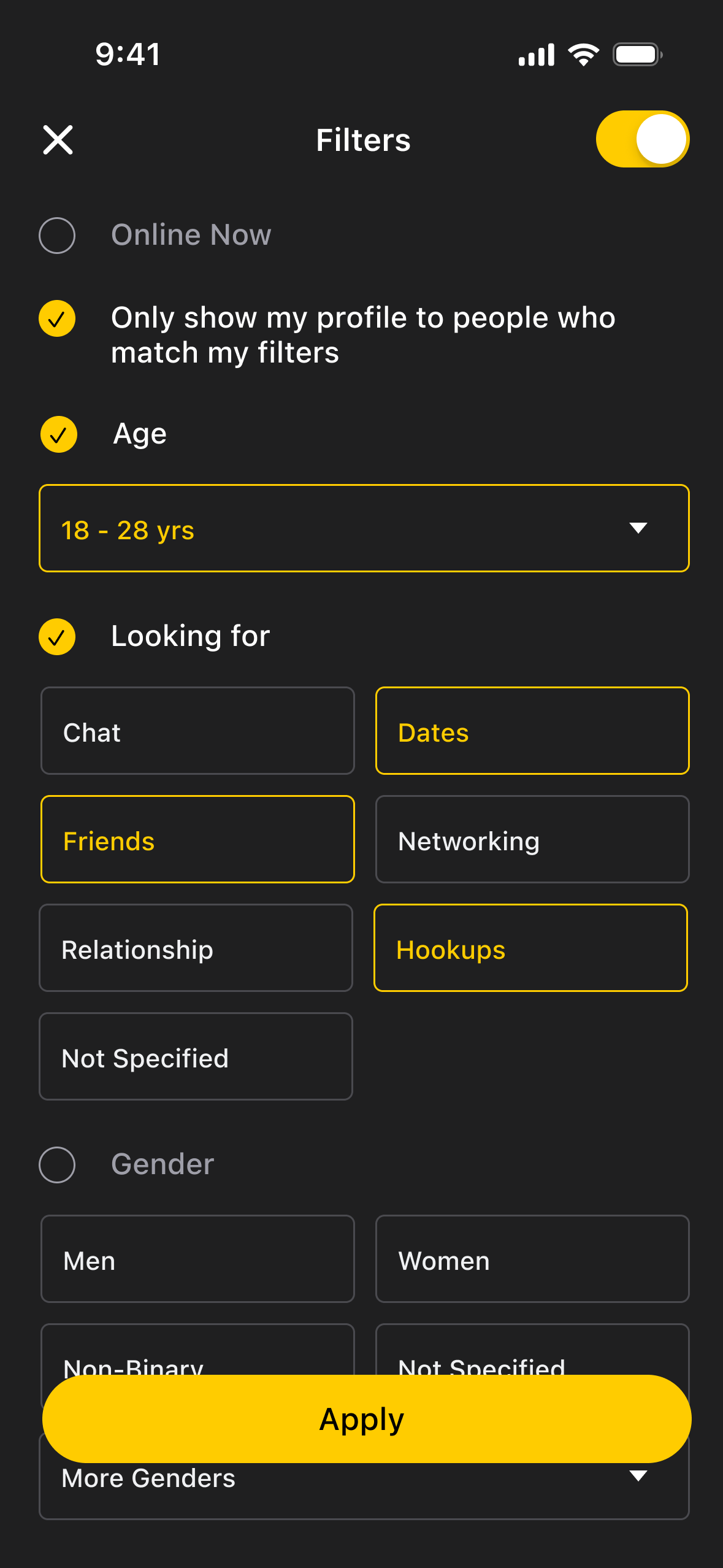
Allow people the option to restrict who can message them to those who match their filters
While some participants liked that anyone can message them on platforms like Grindr, others described how this made them feel uncomfortable. To balance this tension, people should be given the option to make their filters bi-directional.
The mockup on the right provides an example of how this could be implemented on Grindr. It gives people a new option to only show their profile to people who match their filters.
The strength of this design as opposed to a matching system is that it gives agency to those who want extra control over who can message them, without forcing a matching process. In this way, it does not centre interactions around a matching event, which can reduce spontaneity, and it does not punish those who prefer to not have identifiable photos on their profiles. In addition, it allows those who are comfortable with messages from those not matching their filters the ability to keep their profiles open.
If a matching design is used, create opportunities for spontaneous connections
One issue with matching systems is that interactions are centred around a matching event. There's a window in which it's socially acceptable to message but there generally aren't opportunities beyond this. Compare this to grid-based apps, seeing someone nearby again is opportunity enough to reach out again (provided the first conversation went well, of course). If a matching process is involved, designs should consider how elements of spontaneity might be encouraged. For example, providing moments to start or rekindle conversations beyond the initial match event. As Ether Perel, a psychotherapist who talks widely about relationships, suggests, "to remain useful, the best [dating] apps will elicit playfulness, spontaneity and curiosity".