I created this design resource based on research done as part of my PhD in Human-Computer Interaction at the University of Technology Sydney. My research explores how to improve the design of social platforms for and with queer young men. I was supervised by Prof. Elise van den Hoven and Prof. Simon Buckingham Shum.
I created this resource so that my findings would be more accessible to people working in industry on social platforms. Below, I describe the process for creating it, starting with how I conducted the research that informs it.
I conducted my PhD research across three studies. In the first two, I investigated current experiences with social platforms. Then in the third and final study, I ran co-design workshops and evaluation sessions to explore new concepts for design. The image below shows an overview of this process.
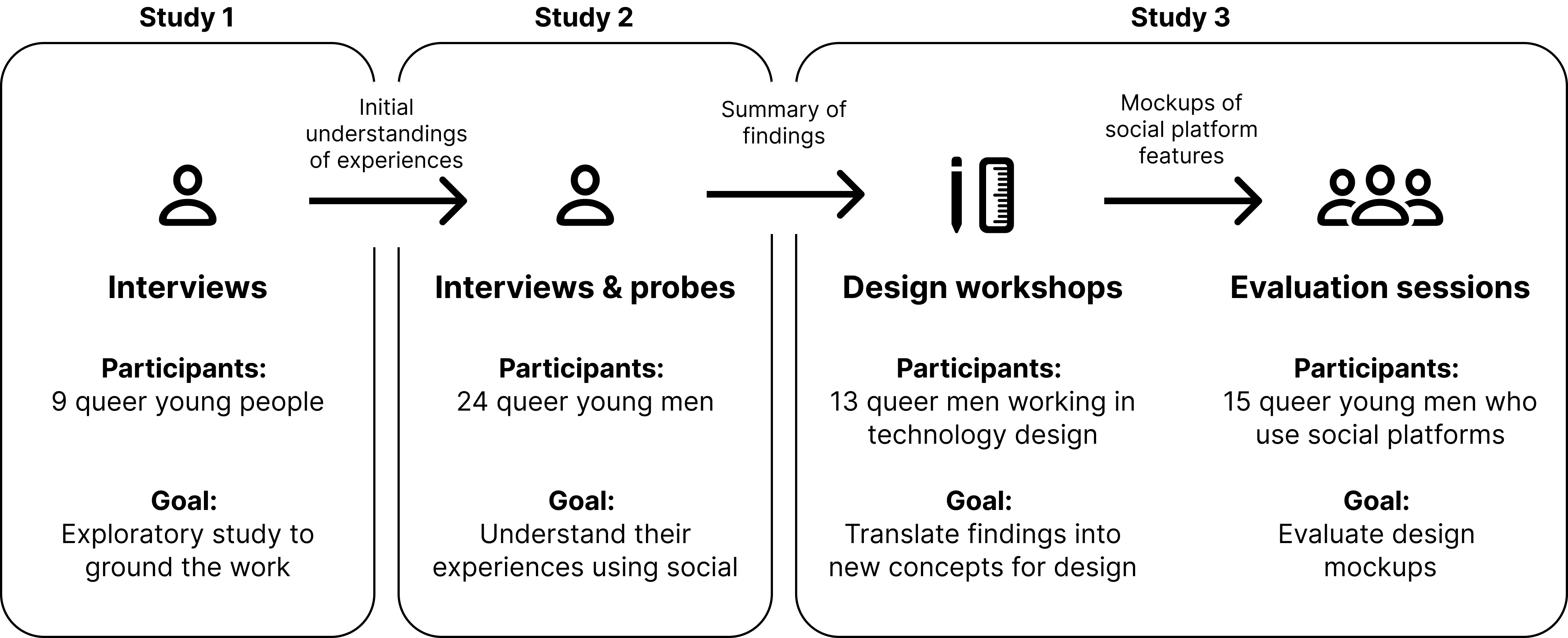
Below I provide a short summary of the research approach but more information about my PhD can be found on my website.
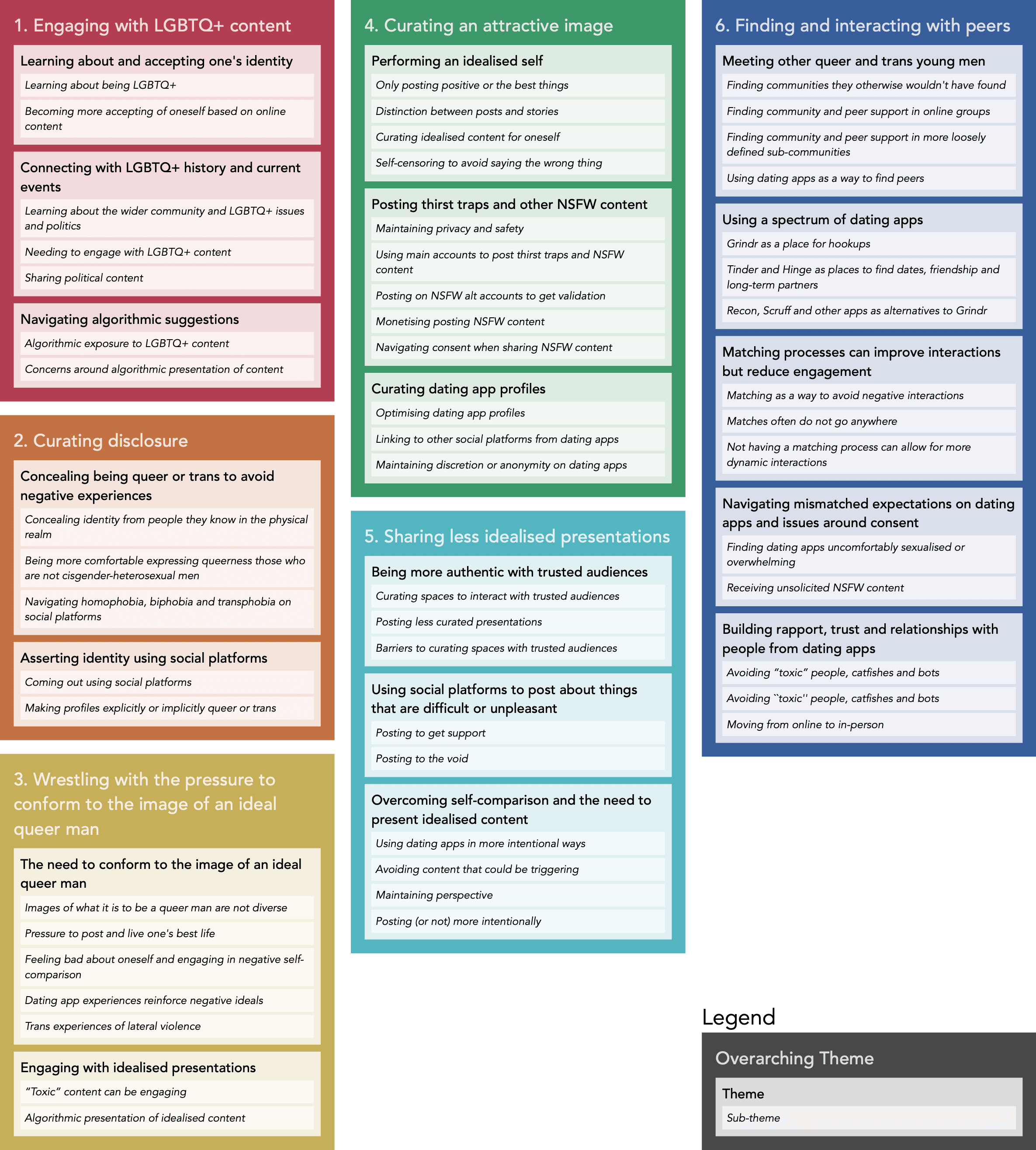
My findings from the first two studies showed that social platforms were a double-edged sword for my participants — they could help them learn about being LGBTQ+, but also open them up to what they described as "toxic" ideals within the queer community. Six main themes were developed from the second study which are shown in the image below.
Findings from these studies then informed a design-led phase where new concepts for social platform features were conceived, prototyped and evaluated. This started with co-design workshops in San Francisco where technology designers envisioned new concepts that responded to the findings. I then took these initial concept ideas and built mockups of them in Figma. The final phase of this work was to evaluate the new design concepts with end-users. To do this, I ran three group evaluation sessions where I presented the concepts and facilitated discussion about them.
Findings from the three studies were used to create the design recommendations that are presented as part of this resource. Although this work was done with queer young men, the recommendations that came out of this work are written to be broadly applicable.
The approach we took in these studies and our engagement with participant shaped our findings and it is important to acknowledge limitations as a result of this. For example, while we present a broad range of design recommendations, they are not exhaustive in describing how to design social platforms. In addition, it was infeasible to evaluate our designs in a real-world context so it is possible that implementations of our recommendations may produce different or unexpected results.